1-855-QUOTEMR

Table of Contents [hide]
Choosing A Window Replacement Contractor: The Expert Vetting Checklist
Who This Is For
This guide is designed for homeowners who are ready to move beyond basic price shopping. If you want to ensure your window project meets structural safety standards, maximizes energy efficiency, and avoids the common pitfalls of poor craftsmanship, this deep dive is for you.
Key Takeaways
- Verification over trust: Always validate insurance and licenses through third-party databases rather than taking the verbal word.
- Technical mastery: A high-quality contractor must explain their methods for flashing, back dams, and moisture management.
- Warranty clarity: Distinguish between a manufacturer's warranty on the product and a workmanship warranty on the labor.
- The 30% rule: Improper installation can reduce the energy performance of a window by up to 30%.
- Contractual protection: Never sign a contract that lacks a specific timeline, debris removal plan, and payment milestones.
- Local expertise: Prioritize contractors who understand local climate challenges like high humidity or coastal salt spray.
Did you know that, according to the U.S. Department of Energy, heat gain and heat loss through windows account for 25% to 30% of residential heating and cooling energy use? While choosing the right glass is vital, the person installing it matters more.
Even the most expensive, triple-pane window will fail if the installation is flawed. Poor seals lead to drafts, wood rot, and mold growth. This guide provides the framework you need to identify a true professional.
The Foundation of Vetting: Beyond the License
Most homeowners ask if a contractor is licensed. This is the bare minimum. To truly protect your home, you must verify the status and the scope of that license.
Every state has different requirements for window replacement professionals. Some require a general contractor license. Others only require a specialty trade registration. Please verify the contractor's status on your local state licensing board's website to make sure they are in good standing.
See Related: How to Choose a Window Replacement Contractor
Validating Insurance Coverage
Insurance is your primary defense against liability. If a worker is injured on your property, you could be held responsible without the proper coverage. To protect yourself, request a Certificate of Insurance (COI) sent directly from the insurance agent.
There are two essential types of insurance you must confirm:
- General Liability: Protects your property from damage.
- Workers' Compensation: Protects the employees on-site.
Do not accept a policy that has expired or one that excludes roofing or window work.
Technical Credentials and Certifications
Look for contractors who invest in their craft. Certifications from organizations like the National Fenestration Rating Council (NFRC) show a commitment to performance standards.
Manufacturer-specific certifications are also valuable. These often mean the contractor has undergone specialized training for a specific product line. This training ensures the installation meets the requirements for the product warranty to remain valid.
|
DOCUMENT TYPE |
PURPOSE |
HOW TO VERIFY |
|
State License |
Legal right to perform work |
State Licensing Board website |
|
General Liability |
Covers property damage |
Call the insurance agent on the COI |
|
Workers' Comp |
Covers worker injuries |
Request proof of current premiums |
|
Manufacturer Cert |
Validates warranty |
Search the manufacturer brand website |
Evaluating Technical Installation Standards
A professional contractor should be able to explain the "physics" of their installation. Window replacement is not just about fitting a box into a hole. It is about moisture management and air sealing.
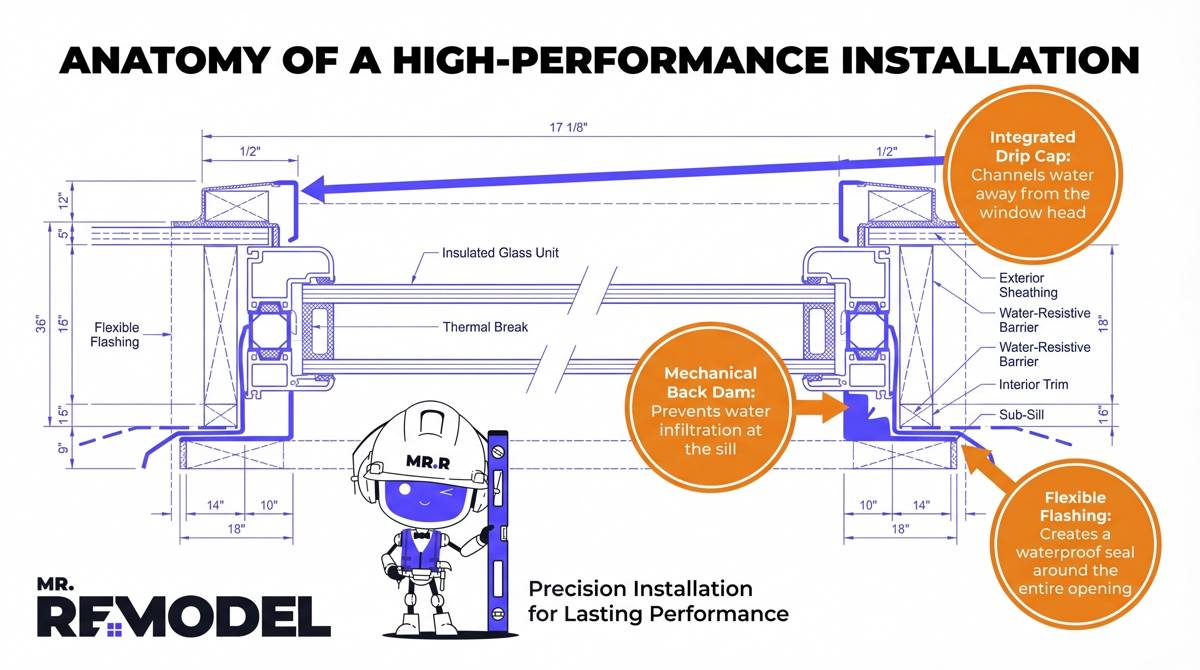
Ask the contractor about their flashing method. Flashing is the material used to direct water away from the window frame. If they do not mention integrated drip caps or sill pans, they may be cutting corners.
The Importance of Back Dams
The Building America Solution Center highlights the use of back dams in quality installations. A back dam is a small lip at the interior edge of the window sill.
This dam prevents water that gets past the exterior seal from entering your wall cavity. If a contractor cannot explain how they handle sill drainage, they are likely relying on caulk alone. Caulk eventually fails, but a mechanical back dam lasts for decades.
Rough Opening Inspections
A quality contractor will inspect the rough opening, which is the structural frame where the window sits, before starting the installation. If the wood is rotted or the frame is out of square, the new window simply will not perform correctly.
Before the work begins, ensure your contractor addresses the following:
- Structural Repairs: How they plan to repair any damaged or rotted framing discovered during the inspection.
- Air Sealing: Their specific plan for sealing gaps to prevent drafts.
- Expanding Foam: The use of low-expansion foam is critical to prevent the window frame from bowing.
See Related: Pocket vs. Full-Frame Installation methods.
Navigating the Contract and Warranty Split
One of the biggest points of confusion in window replacement is the warranty. Most homeowners assume one warranty covers everything, but in reality, there is a significant split between the product and the labor.
The Two Types of Warranties
- Manufacturer Warranty: Covers the glass, frame, and hardware, usually for 20 years to a lifetime. However, this rarely covers the labor costs to replace a defective part.
- Workmanship Warranty: Provided by the contractor to cover the installation process. If the window leaks due to poor leveling, the contractor is responsible.
|
Pro Tip: Mr. Remodel data shows top-tier contractors offer at least a 10-year workmanship warranty. Beware of one-year guarantees, as leaks often take several seasons of heavy rain to manifest. 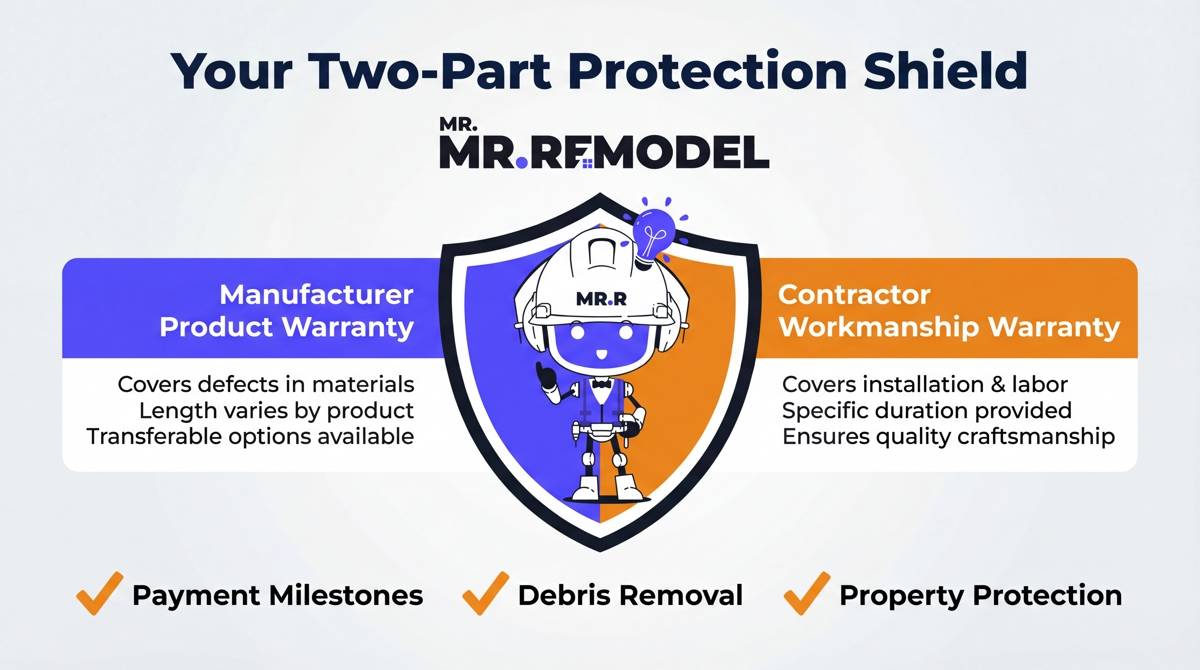 |
Essential Contract Clauses
Never rely on a handshake or a simple invoice. A professional contract serves as your roadmap and must include:
- Detailed Payment Schedule: A common standard is 30% down, 40% upon delivery, and the final 30% after the final inspection. Avoid anyone demanding 100% upfront.
- Debris and Site Management: The contract should explicitly state that the contractor is responsible for debris removal, including hazardous old glass or lead-based paint dust.
- Property Protection: Specific details on how they will protect interior furniture and exterior landscaping using drop cloths and magnetic sweeps for stray nails.
Debris and Site Management
Window replacement is a messy process. Old glass and lead-based paint dust can be hazardous. Your contract should explicitly state that the contractor is responsible for debris removal.
They should also detail how they will protect your interior furniture and exterior landscaping. This includes using drop cloths and magnetic sweeps to pick up stray nails. A clean job site is a sign of a professional operation.
See Related: Manufacturer Warranty vs Installation Warranty
Analyzing Estimates and Avoiding Low-Ballers
Price is always a factor, but the lowest bid is often the most expensive in the long run. High-quality labor and premium materials have a market cost; therefore, a bid that is significantly lower than the others is a major red flag.
When evaluating a low-ball bid, consider that the contractor might be:
- Skipping Essentials: Cutting corners on permit fees or necessary project documentation.
- Using Unqualified Help: Relying on day labor rather than skilled, insured professionals.
- Cutting Material Quality: Using inferior sealants that are prone to cracking within just two years.
Always compare the scope of work rather than just the final number to ensure you are getting a true apples-to-apples comparison.
See Related: Red Flags When Hiring Window Companies
Understanding Material Costs
The cost of the window itself is only one part of the equation. High-performance glass with Low-E coatings and argon gas fills adds to the price. However, these features provide the best return on investment through energy savings.
Refer to the Federal Trade Commission (FTC) for advice on hiring contractors. They recommend getting at least three written estimates. This gives you a baseline for what a fair price looks like in your specific zip code.
|
Factor |
Standard Quality |
Premium Quality |
|
Glass |
Double-pane |
Triple-pane / Low-E |
|
Sealant |
Basic Caulk |
High-performance Silicone |
|
Flashing |
Tape only |
Metal drip caps and sill pans |
|
Warranty |
1 Year Labor |
10+ Year Labor |
Local Factors and Environmental Challenges
Your location should dictate your choice of contractor, as specific environments require specialized materials and expertise:
- Coastal Areas: Contractors must understand the corrosive power of salt spray and should recommend windows with stainless steel hardware to prevent rust.
- High-Humidity Areas: The primary focus should be on proper moisture barriers to prevent rot and mold.
- Hurricane-Prone Regions: The contractor must be well-versed in impact-rated glass and specific local wind-load codes.
Regarding timing, Mr. Remodel data indicates that lead times for custom windows currently average 6 to 10 weeks. Be wary of a contractor who promises a two-week turnaround for custom sizes; they may be over-promising or planning to use "off-the-shelf" stock that won't fit your home perfectly.
Do you need an estimate you can trust? Contact Mr. Remodel to connect with top-rated local contractors who offer fair, transparent pricing.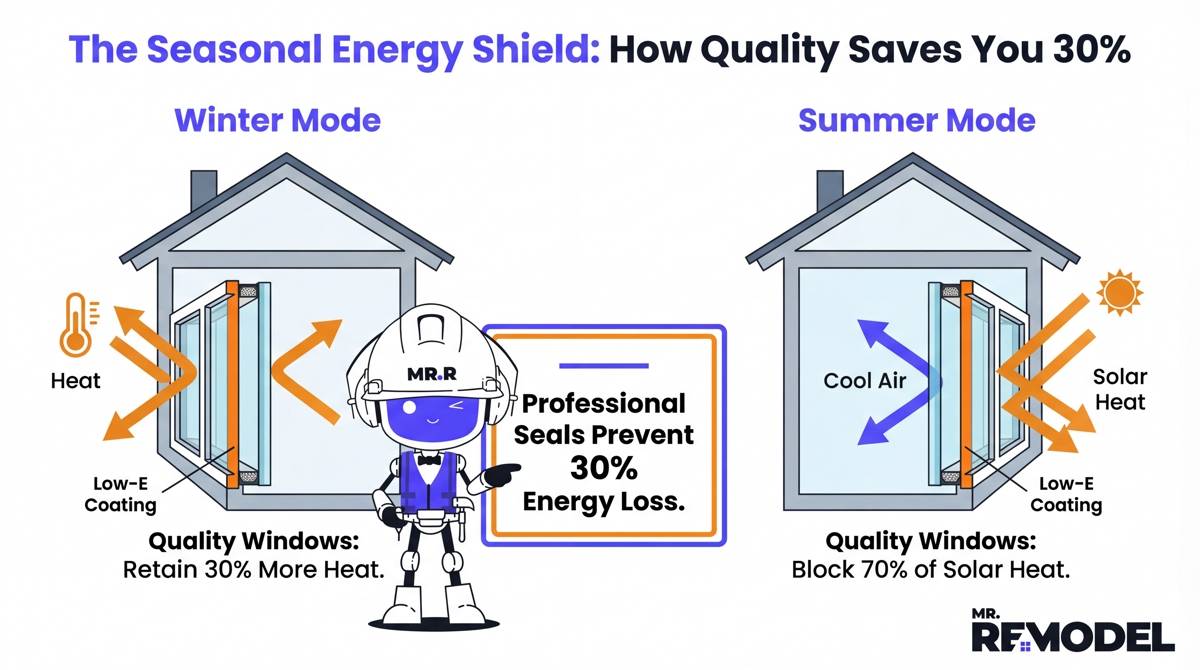
The Interview: Questions to Ask Every Professional
When you meet with a potential contractor, treat it like a job interview. You are the hiring manager. Their answers will reveal their level of expertise and professionalism.
Do not be afraid to ask technical questions. A true expert enjoys explaining their process. If they become defensive or dismissive, it is a sign they may not be the right fit for your project.
Critical Interview Questions
- Who will be the on-site supervisor? You need to know who is responsible for the daily work.
- How do you handle unforeseen structural damage? Ask for their process if they find rot under the old frame.
- Are you Lead-Safe Certified? This is a legal requirement for homes built before 1978.
- Can I see a current Certificate of Insurance? Do not accept a copy; ask for a fresh one from their agent.
- What specific flashing system do you use? Listen for mentions of sill pans or flexible flashing tapes.
- How many projects like mine have you completed this year? Local references are essential.
See related: Questions to Ask Window Installers.
Verifying References and Past Work
A contractor’s past performance is the best predictor of your future satisfaction. Ask for a list of three references from projects completed in the last six months.
When you call these references, ask about the contractor's communication style. Were they on time? Did they keep the job site clean? Most importantly, how did they handle any problems that arose?
Viewing the Work in Person
If possible, drive by a home they have recently completed. Look at the exterior finish. Is the caulking smooth and professional? Is the trim neatly installed?
Online reviews on neutral platforms can also provide insight. Look for patterns in the feedback. One bad review might be an outlier, but a recurring complaint about communication or leaks is a major red flag.
Finalizing the Selection and Starting the Project
Once you have vetted the license, audited the technical plan, and checked references, it is time to make a decision. Choose the contractor who provides the best balance of technical skill, warranty protection, and transparent pricing.
Before the work begins, ensure you have a signed copy of the contract and all necessary permits. The National Fenestration Rating Council recommends keeping all window labels until the project is finalized. These labels contain the energy performance data you may need for future tax credits.
|
Step |
Action Item |
Priority |
|
1 |
Verify State License |
Critical |
|
2 |
Confirm Workers' Comp |
Critical |
|
3 |
Review Technical Flashing Plan |
High |
|
4 |
Call 3 Recent References |
High |
|
5 |
Sign Detailed Contract |
Critical |
See related: Window Replacement Permits and Inspections
Frequently Asked Questions
How long does a typical window replacement project take?
Most residential window replacements can be completed in one to three days. This depends on the number of windows and the complexity of the installation. Full-frame replacements take longer than pocket installations because they involve more interior and exterior trim work.
Does Mr. Remodel provide the windows or just the labor?
Mr. Remodel connects you with professional contractors who provide full-service solutions. This includes helping you select the best window materials for your climate and performing the professional installation.
What is the most common mistake when choosing a contractor?
The most common mistake is choosing based solely on the lowest price. This often leads to hiring contractors who lack proper insurance or use sub-standard installation methods that cause water damage later.
How do I know if I need a permit for window replacement?
In most jurisdictions, a permit is required if the structural opening of the window is being changed. Even for simple "like-for-like" replacements, many cities require a permit to ensure energy codes are met. A professional Mr. Remodel contractor will handle the permit process for you.
What is a Lead-Safe certified contractor?
If your home was built before 1978, it may contain lead-based paint. The EPA requires contractors to be Lead-Safe Certified to ensure they follow specific containment and cleanup procedures to protect your family from toxic dust.
Can Mr. Remodel help me compare different window brands?
Yes. Our experts and partner contractors can provide data on various manufacturers. We help you compare U-factors, Solar Heat Gain Coefficients, and warranty terms to find the best fit for your budget.
Should I stay home during the window installation?
While you do not need to be in the room where work is happening, it is helpful to be home during the start and end of the project. This allows you to walk through the site with the supervisor and address any immediate questions.
Take Command of Your Home Renovation
Choosing a window replacement contractor is a significant decision that impacts the comfort, safety, and value of your home. By moving past surface-level quotes and focusing on technical verification, you protect your investment from the risks of poor craftsmanship.
A true professional will not hesitate to show you their license, explain their flashing methods, or provide a long-term workmanship warranty. Remember, the quality of the installation is what truly makes a window high-performance.
Ready to find a contractor who meets these elite standards? Mr. Remodel simplifies the vetting process by connecting you with high-quality professionals in your area.
Get your free window replacement quotes and start your project with confidence.