1-855-QUOTEMR

Table of Contents [hide]
Who This Is For
This structural engineering guide is tailored for single-family homeowners experiencing overflowing roofline channels, water pooling near their foundations, or fascia board deterioration. If your home features a steep roof pitch, metal roofing, or faces severe seasonal downpours, this resource will break down the mechanics of upgrading to high-capacity drainage.
Key Takeaways
- System Capacity: Upgrading to oversized 6-inch gutters increases your drainage flow capacity by roughly 50% to 70%, allowing channels to hold 2.0 gallons of water per linear foot.
- Structural Load: Fully loaded 6-inch gutter systems hold over 60 gallons of rainwater along a standard 30-foot run, requiring heavy-gauge aluminum and reinforced fascia mounting.
- Replacement Priority: Proprietary field tracking reveals that 79.7% of all gutter leads request full system replacements rather than patch fixes on failing, undersized troughs.
- The Mitigation Crisis: Nearly one-fifth of property owners upgrading their systems experience a high-urgency timeline, requiring full contractor deployment within seven days to halt active water damage.
- Regional Risk Hotspots: Demand for high-capacity systems correlates directly with intense precipitation zones, peaking in storm-heavy markets across North Carolina, Florida, and Pennsylvania.
Are you tired of watching sheets of rainwater cascade over the edge of your roofline during heavy summer storms? While standard builder-grade 5-inch gutters are acceptable for mild climates, they frequently choke and overflow when faced with severe, high-velocity downpours.
According to municipal stormwater management data published by the Town of Manlius, a single inch of rainfall landing on a standard 1,000-square-foot roof structure yields a staggering 560 gallons of water. Safely capturing and redirecting this massive volume of sudden surface runoff requires calculated drainage engineering.
When a drainage system cannot handle incoming volume, water flows backward into your soffits or pools directly against your home's foundation walls. At Mr. Remodel, we analyze thousands of active exterior remodeling projects to help you evaluate high-capacity 6-inch configurations that safeguard your structural equity.
The Engineering Mechanics of 6-Inch Gutters vs. 5-Inch Systems
To understand why standard channels fail, you must examine the physical dimensions of your roofline drainage. Standard residential gutters utilize a 5-inch opening that easily becomes overwhelmed on steep roof pitches or slick metal surfaces, which accelerate water velocity.
Oversized 6-inch gutters feature a wider mouth and a significantly deeper trough profile. This added depth completely alters the internal physics of your water removal system, allowing the channel to carry approximately 2.0 gallons of water per linear foot.
This change represents a massive 70% flow capacity increase over a standard 5-inch trough, which maxes out at a low 1.2 gallons per foot. Upgrading ensures your home easily manages sudden cloudbursts without water splashing over the outer rim.
Accounting for the Fully Loaded Weight Load
While the massive capacity increase solves severe overflow issues, it introduces an intense physical weight load that standard home framing is unequipped to support without proper modifications. Water is incredibly heavy, weighing roughly 8.34 pounds per gallon.
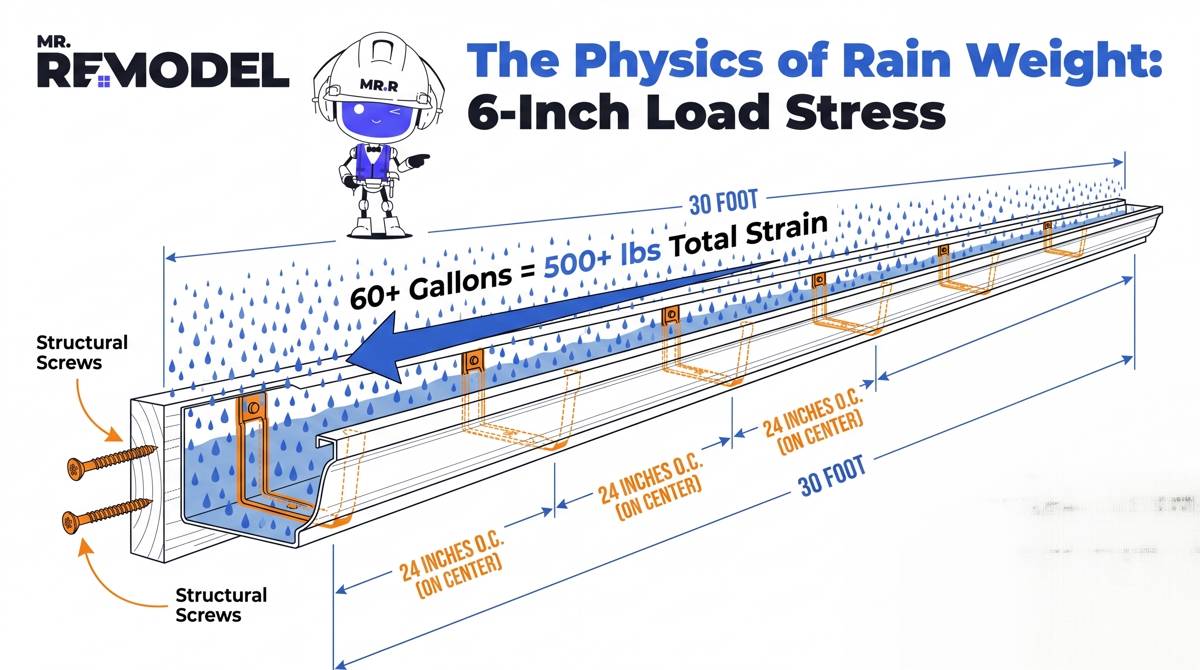
During an intense storm, a standard 30-foot run of fully loaded 6-inch gutters will hold more than 60 gallons of water, putting over 500 pounds of deadweight strain on your home's exterior fascia boards. Cheap, thin metals will rapidly sag, buckle, and rip away from the structural rafter tails under this pressure.
To survive these intense weight shifts, premium oversized installations require heavy-gauge (.032) seamless aluminum channels. Crews must use structural screws and reinforced internal hidden hangers spaced no more than 24 inches apart to lock the system down safely.
Managing Widespread Failures and Compressed 7-Day Timelines
When a home's drainage infrastructure proves to be permanently undersized, attempting small maintenance patches or cleanings is a waste of capital. Patch fixes cannot alter the physical volume limitations of a narrow gutter channel.
Our proprietary national database of 4,614 localized gutter queries confirms this reality. An overwhelming 79.7% (3,681 customers) of affected property owners demand a full system tear-off and replacement, proving that patch fixes fail to solve systemic overflow problems.
See Related: Should You Repair or Replace Your Gutters? Cost Breakdown
The Active Water Mitigation Emergency
Homeowners rarely realize their gutters are failing until water actively breaches the home envelope. Once wood rot compromises your fascia boards or foundation leaks saturate your basement, the project transitions into a high-urgency crisis.
Our timeline analytics show that a critical 18.6% of customers (861) require full project commencement within a compressed 7-day window. These homeowners are experiencing active property damage and require the rapid deployment of custom seamless machinery to stabilize their home infrastructure.
According to flood safety criteria from the NSSL Severe Weather 101, rapid runoff from steep domestic surfaces easily overwhelms builder-grade components. Acting quickly to upgrade the system volume is necessary to prevent severe landscaping erosion and costly structural settlement.
See Related: How Bad Gutters Cause Foundation Damage and What It Costs to Fix
Regional Weather Volatility and System Customization
The demand for oversized 6-inch gutter systems is heavily concentrated in geographical regions that experience extreme precipitation trends or strict coastal building codes. Our internal database tracks these distinct weather-driven correlations across high-volume state markets:
- North Carolina (465 inquiries): Homeowners face sudden, severe Piedmont thunderstorms and require wide troughs to clear water before it backs up under roofing shingles.
- Florida (429 inquiries): Properties face tropical storms and hurricane-force deluges, requiring heavy-gauge seamless systems to maintain structural integrity.
- Pennsylvania (298 inquiries): Buildings suffer from harsh freeze-thaw cycles, where undersized gutters trap standing water that freezes into heavy, destructive ice dams.
- Texas (282 inquiries): Homes deal with intense spring monsoons that shed immense water volume off wide residential roof footprints in minutes.
Recommendations from the FLASH Resilient Housing Guidelines confirm that fortifying your exterior drainage lines is a critical wind and water mitigation defense. Upgrading system capacity prevents water from driving behind your exterior siding during high-wind storms.
See Related: Best Gutters for Heavy Rain Areas
Finding Certified Architectural Exterior Contractors
Because oversized gutter conversions place immense physical demands on your roofline framing, you cannot trust this home improvement task to a standard neighborhood handyman. Finding a crew capable of custom-extruding heavy-gauge seamless metal on-site is essential.
When vetting certified local contractors for exterior remodeling, verify they use precise digital slope pitching equipment. A minor placement error of even an eighth of an inch will cause hundreds of pounds of water to sit stagnant, accelerating wood decay along your roofline.
Partnering with certified experts ensures your custom downspouts and mitered corners are hand-soldered or sealed using industrial triple-polymer compounds. Investing in specialized crews ensures your heavy-gauge channels perform flawlessly for decades, keeping your home foundation completely dry.
Stop letting overflowing water rot your home's exterior fascia and damage your landscaping. Let Mr. Remodel match you with certified local seamless technicians today. Request a quote for professional gutter installation to secure a rapid, high-capacity upgrade slot.
Frequently Asked Questions
What is the mechanical benefit of an oversized 6-inch gutter?
A 6-inch gutter holds roughly 2.0 gallons of water per linear foot, providing a 50% to 70% increase in total flow capacity over standard 5-inch channels. This extra volume prevents overflows on steep roofs or during high-velocity downpours.
How much do oversized 6-inch seamless gutters cost?
Oversized installations generally command a 20% to 40% premium over standard systems, averaging between $12 and $22 per linear foot. Total costs depend on material selection, layout complexity, and fascia board reinforcement demands.
Why do 6-inch gutters require specialized installation labor?
Fully loaded 6-inch gutters hold massive amounts of water, weighing over 500 pounds on a standard 30-foot run. Installers must use heavy-gauge (.032) aluminum and space heavy-duty hidden hangers tightly to prevent structural sagging or collapse.
Can a homeowner perform a 6-inch gutter conversion as a DIY project?
No. Standard retail stores only sell flimsy sectional channels that leak at the joints. High-performance oversized systems require industrial truck-mounted rolling mills to extrude completely seamless runs tailored to your exact property footprint.
What states register the highest demand for high-capacity gutters?
Our internal metrics track the highest demand in high-precipitation and severe storm markets, led by North Carolina (465 homeowners), Florida (429 homeowners), Pennsylvania (298 homeowners), and Texas (282 homeowners).
Safeguard Your Home Infrastructure and Structural Equity
Upgrading to an oversized 6-inch gutter installation requires balancing a nominal upfront material premium against verified structural fluid dynamics. Preparing for heavy-weight loads and severe seasonal storms prevents expensive rot and foundation failures.
By focusing on a complete, seamless tear-off and choosing heavy-gauge aluminum, you turn a routine exterior repair into a robust property defense asset. Perfecting your roofline water diversion shields your landscaping, reinforces your roofline framing, and preserves your foundational structural equity.
Ready to secure a clear, high-capacity plan for your property? Get your free, no-obligation quote from Mr. Remodel to analyze your local storm parameters and complete your upcoming drainage upgrade with absolute peace of mind.