1-855-QUOTEMR

Table of Contents [hide]
Who This Is For
This guide is designed for homeowners who are currently reviewing window replacement estimates and need to justify the cost of an upgrade. If you are trying to decide whether the convenience of tilt-in cleaning is worth the higher project total, this data-driven report provides the financial clarity you need. We analyze the differences between these styles based on actual 2025 and 2026 project metrics.
Key Takeaways
- Project Scope: The average window replacement involves 5.7 units, meaning small per-window premiums significantly impact the total budget.
- Economic Baseline: Modern window projects currently average a closed-won ticket of $16,511 across our data centers.
- Ventilation Logic: Double-hung units offer superior cross-ventilation, allowing warm air to escape through the top sash while cool air enters through the bottom sash.
- Cleaning Access: Tilt-in sashes allow for interior cleaning of second-story glass, eliminating the need for professional exterior services.
- Failure Metrics: Seal failure and argon gas leaks account for 98% of window replacements rather than mechanical track issues.
The debate between single-hung and double-hung windows is one of the most common dilemmas in residential remodeling. This is not merely a question of which sash slides up and down. This decision involves strategically allocating thousands of dollars within your exterior improvement budget.
Homeowners often feel pressured to choose based on vague claims about durability or ease of use. However, our 2025 dataset of over 27,000 window leads proves that this choice must be calculated as a scaled investment. Because windows are rarely replaced one at a time, a small difference in the unit price can lead to a substantial increase in the total project ticket.
Understanding the operational differences between these two systems is the first step toward a high-performance home. While single-hung units remain a standard for many new constructions, the remodel market is shifting toward the flexibility of the double-hung design. This guide breaks down the math, the mechanics, and the maintenance realities of both styles.
Comparing Operational Mechanics and Ventilation Performance
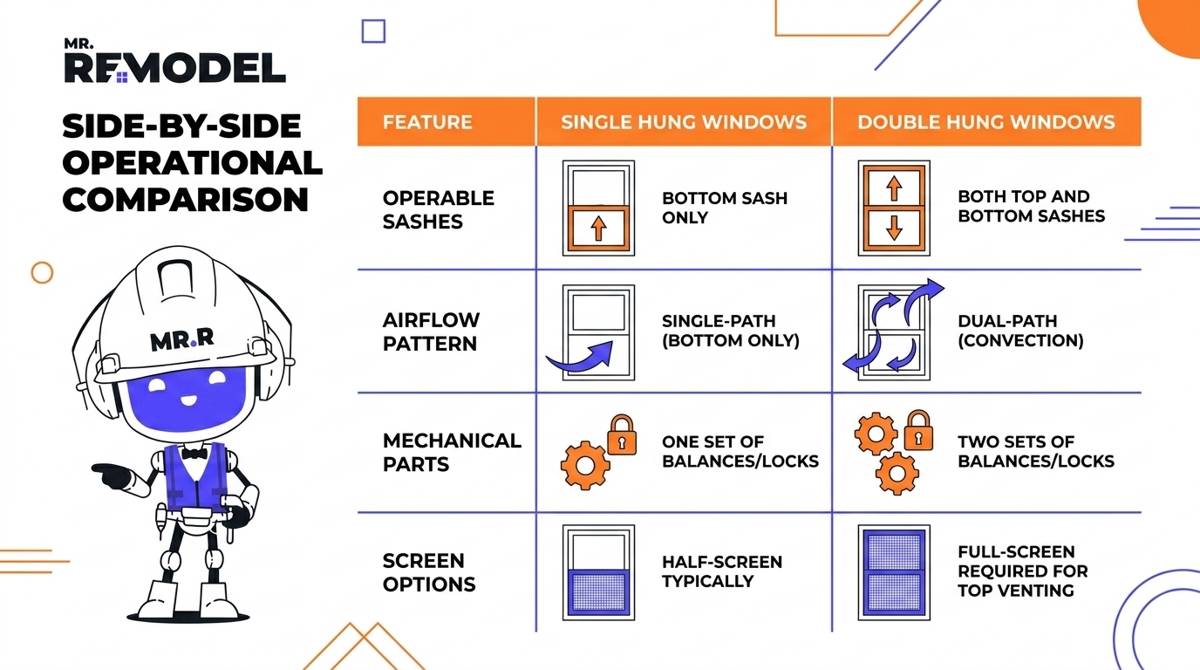
The primary physical difference between these two window styles is found in the number of operable sashes. In a single-hung window, the top sash is permanently fixed in place while the bottom sash slides vertically. In a double-hung window, both the top and bottom sashes move independently.
Airflow and Stagnant Heat
This difference fundamentally changes how your home breathes. The U.S. Department of Energy provides guidelines on window types and technologies that highlight the importance of airflow patterns. Because heat rises, opening the top sash allows hot air near the ceiling to escape. Simultaneously, opening the bottom sash allows cooler exterior air to enter near the floor.
Indoor Air Quality
Dual-sash operation provides superior cross-ventilation compared to single-hung units. The Environmental Protection Agency suggests that proper ventilation is a key factor in improving indoor air quality. By more effectively flushing out indoor air pollutants, double-hung windows contribute to a healthier living environment. This is especially beneficial in rooms with high moisture levels, like kitchens or laundry rooms.
Side-by-Side Operational Comparison
See Related: Window Problems and Solutions: Why 98% of Repairs End in Replacement.
Maintenance and Cleaning Realities for Multi-Story Homes
The primary selling point for double-hung windows is the tilt-in cleaning feature. Both sashes can be tilted inward toward the room. This allows you to clean the exterior glass without stepping outside or using a ladder. This is a significant functional upgrade over single-hung units.
The Tilt-In Cleaning Advantage
Single-hung windows often require you to go outside and use a hose or a ladder to clean the exterior of the glass. For the top fixed sash, this can be dangerous on a second story. Double-hung windows solve this problem by allowing both sashes to pivot. This feature is a logistical necessity for many multi-story homes where professional cleaning services are expensive.
Strategic Capital Allocation
If your home has multiple levels, the financial benefit of double-hung windows increases significantly. Professional exterior window cleaning services can cost hundreds of dollars per visit. By investing the extra capital into double-hung frames during your $16,511 project, you eliminate these recurring maintenance costs. For families, the safety of cleaning from inside the house is often worth the upgrade.
Mr. Remodel connects you with vetted local specialists to help with financial decisions. We understand homeowners want to maximize their budget and ensure long-term ease. Our network includes professionals providing transparent estimates. Get your free quote now for window replacement and quick installation.
See Related: Window Costs and Value | Real Project Data & ROI Guide
Financial Impact of the Double-Hung Multiplier Effect
A common mistake in the planning phase is looking at window prices in a vacuum. A contractor might mention that a double-hung frame carries a $75 premium over a single-hung model. While $75 sounds negligible, it is rarely the final cost of the decision.
Our data indicates that the average replacement project involves 5.48 windows per lead and 5.70 windows per closed-won job. When you apply the upgrade premium across an entire home, the financial impact becomes clear. Using the average job size, we can see the true upgrade cost:
Project Upgrade Cost = 5.70 windows x $75 = $427.50
This $427.50 increase must be weighed against the total project baseline. With the average closed-won window ticket currently sitting at $16,511, you must decide if that extra capital is better spent on frame upgrades or glass technology. If you own a single-story ranch, the cleaning benefit is less pronounced. In this scenario, saving the premium by sticking to single-hung units might be the smarter financial move.
The saved budget is often better spent on glass performance. ENERGY STAR data on the benefits of certified windows shows that upgrading to argon-filled glass provides a higher Return on Investment. Redirecting your capital into specialized coatings ensures your home stays comfortable during extreme summer or winter months.
See Related: Low-E Glass Explained | Low-E 366 vs. Passive Solar (2026)
Durability and Failure Statistics for Modern Window Frames
A common myth pushed by some contractors is that single-hung windows are inherently more durable. The argument is that fewer moving parts lead to fewer mechanical failures. While this may sound logical, our data tells a different story about why windows actually fail in the 2026 market.
Seal Failure vs. Mechanical Track Issues
Our records show a 98.3% replacement rate for failing windows. Mechanical track failure is rarely the primary culprit. Instead, modern composite windows usually fail at the glass seal. Once the seal is broken, the argon gas between the panes escapes. This results in foggy glass and a total loss of thermal resistance. Whether a window is single or double-hung, it uses the same insulated glass technology.
Structural Stability of the Frame
High-performance frames from reputable manufacturers are built to handle the weight of both operable sashes without sagging. You should base your decision on your needs for ventilation and cleaning rather than a fear of mechanical failure. Modern constant force balances have replaced older, less reliable spring systems. This ensures smooth operation for both styles regardless of the number of moving parts.
See Related: Window Problems and Solutions: Why 98% of Repairs End in Replacement.
Frequently Asked Questions
Is the air leakage rate higher in double-hung windows?
In the past, double-hung windows were more prone to air leaks because they had two moving sashes. However, modern manufacturing standards utilize advanced weatherstripping and interlocking sashes. When properly installed, the difference in air infiltration between a high-quality single-hung and double-hung window is negligible for the average homeowner.
How much extra does a double-hung window cost?
While individual unit prices vary by material, you should generally expect a premium of $50 to $100 per window. For the average project size of 5.7 windows, this adds roughly $285 to $570 to your total project cost. This investment should be viewed in light of the long-term savings from professional cleaning services and improved air circulation.
Can I mix single and double-hung windows in the same home?
Yes, many homeowners choose to mix styles to optimize their budget. You might install double-hung windows on the second floor for easy cleaning and use single-hung windows on the first floor, where exterior access is easy. Most manufacturers offer both styles within the same product line to ensure a matching aesthetic.
Stop Guessing and Get Exact Project Math
Don't guess how much a double-hung upgrade will cost your specific home based on generic internet averages. Your window count, frame material, and glass requirements will all play a role in the final investment. The choice between these two styles should be a data-driven decision based on your home's layout and long-term maintenance goals.
Submit your project size to the vetted Mr. Remodel network today. Our professionals will provide a side-by-side, itemized quote for both single and double-hung systems. This allows you to weigh the benefits of tilt-in cleaning and cross-ventilation against your specific renovation budget. Contact us for expert window replacement services and secure a priority inspection for your home today.