1-855-QUOTEMR

Table of Contents [hide]
Who This Is For:
Homeowners comparing nearby professionals for a multi-window replacement project.
Key Takeaways:
- Verify Local Credentials: Check applicable licensing, insurance, and permit knowledge.
- Assess Regional Experience: Ask how local climate influences product recommendations.
- Compare Written Scopes: Review equivalent products, installation methods, and finish work.
- Confirm Capacity: Discuss crews, product availability, and scheduling.
- Review Local Support: Clarify warranty service and post-installation responsibilities.
Choosing local window replacement experts involves more than finding the nearest installer. Homeowners should compare regional experience, product recommendations, installation practices, project capacity, written estimates, and support after completion.
Based on Mr. Remodel data, the median window installation inquiry involved five windows. This common project size requires a professional capable of coordinating measurements, products, installation details, and quality checks across several openings.
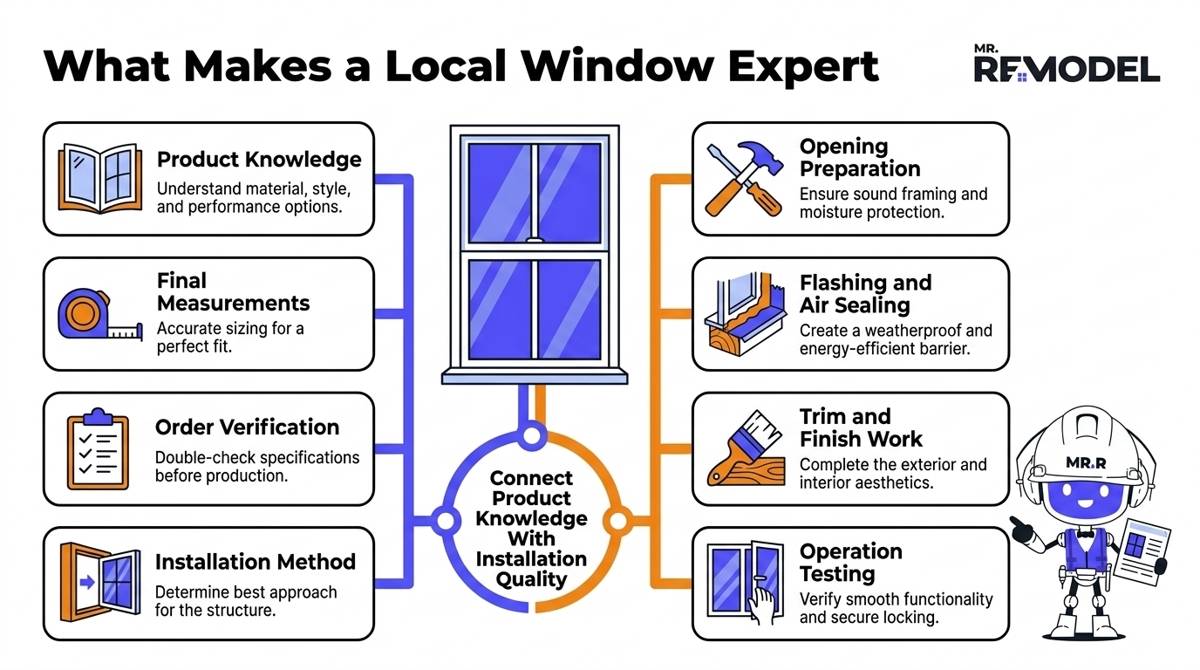
What Makes a Window Replacement Expert?
A window replacement expert should understand the complete process, from evaluating existing openings to completing the final inspection. Product knowledge should be paired with sound measurement, installation, and project-management practices.
Product and Installation Knowledge
The contractor should explain why a proposed window suits the home and how it will be installed. The written scope should identify the product, operating style, frame, glass, installation method, and finish work.
Recommendations should relate to the actual project rather than general claims about one material or brand. Different openings may require different dimensions, configurations, or installation details.
A Documented Installation Process
Ask how the company handles final measurements, order verification, opening preparation, flashing, insulation, air sealing, trim, and operation testing.
The Department of Energy’s Window Replacement Checklist emphasizes following relevant codes, standards, manufacturer instructions, and installation specifications. A local expert should explain how those requirements apply to the proposed work.
Benefits of Hiring a Local Window Professional
A nearby contractor may be familiar with regional construction methods, permit offices, climate conditions, and commonly used window products. Proximity can also make consultations and warranty visits easier to coordinate.
Regional Project Experience
Ask for examples of homes with similar wall materials, siding, window types, and exposure conditions. Relevant project experience is more informative than a general statement about years in business.
A contractor who regularly works in the area may also understand common opening conditions and local inspection procedures. Ask specific questions about how that knowledge applies to your home.
Local Service After Installation
Find out whether warranty requests are handled by the original installer, a separate service team, or the manufacturer. The written proposal or warranty should identify the service process, scheduling procedure, and required documentation.
See Related: Choosing a Window Replacement Contractor
Local Climate and Product Recommendations
Climate can influence window selection, but recommendations should be supported by specific performance information. Ask how local heating, cooling, sunlight, moisture, wind, and weather conditions affected the proposed configuration.
Compare Complete Window Ratings
Frame material and pane count do not describe a window’s complete performance. Review the NFRC-certified ratings for the exact frame-and-glass configuration.
ENERGY STAR guidance for residential windows explains that qualifying windows are independently tested and certified, with performance criteria that vary by climate zone. A familiar brand may offer several configurations with different ratings, so the proposal should identify the exact product.
Discuss Orientation and Exposure
Windows at different elevations may experience varying amounts of sun, shade, rain, and wind. Ask whether those conditions justify different glass packages or installation details.
Any opening-specific recommendations should appear in the product schedule before ordering.
See Related: Energy-Efficient Windows
Permits, Credentials, and Installation Requirements
Licensing, permit, and inspection requirements vary by state and locality. The written proposal should explain how applicable requirements will be handled.
Confirm Local Credentials
Ask for the contractor’s legal business name, applicable license information, and proof of insurance. Use the relevant state, county, or municipal resources to confirm details as needed.
The Federal Trade Commission recommends considering licensed and insured contractors, verifying credentials with the appropriate government office, obtaining multiple written estimates, and carefully reviewing the contract.
Assign Permit Responsibility
The proposal should state whether permits and inspections are required, who obtains them, who pays the fees, and who addresses corrections. These responsibilities can affect the project scope and schedule.
Review Flashing and Air Sealing
Installation details should match the window, wall assembly, manufacturer instructions, and applicable requirements. Caulk alone should not be presented as a complete water-management system.
The contractor should explain how flashing will connect with the surrounding wall and how the gap around the unit will be insulated and sealed. The Building America Solution Center provides technical guidance for air sealing window and door rough openings.
Comparing Estimates and Project Scopes
Two estimates can have different totals because they include different products, installation methods, trim work, disposal services, permits, or warranties.
Based on Mr. Remodel data, 52.94% of window installation inquiries involved at least five windows. For a multi-window project, request an opening-by-opening schedule that keeps dimensions, products, and installation methods organized.
Review each estimate for:
- Manufacturer, product line, and configuration
- Window quantity and measurement responsibility
- Pocket or full-frame installation
- Opening preparation, flashing, insulation, and sealing
- Interior and exterior trim
- Painting, disposal, permits, and cleanup
- Payment terms, exclusions, and change-order procedures
- Manufacturer and workmanship warranties
Missing information should be clarified before comparing totals. A lower estimate may represent a narrower scope rather than a better value.
Plan for Whole-Home Capacity
Based on Mr. Remodel data, 27.07% of window installation inquiries involved at least 10 windows. Large projects require enough crew capacity to protect exposed openings, maintain consistent workmanship, and inspect every completed unit.
Ask how many installers will be assigned, who will supervise them, and whether the project will be completed continuously or in stages. Similar-looking products should be labeled and matched with their assigned openings before removal begins.
Ready to compare project-specific scopes from nearby professionals? Get a free local window replacement quote today.
Warranties and Post-Installation Support
Manufacturer and workmanship warranties address different responsibilities. A manufacturer warranty may cover eligible defects involving the window, glass, finish, seals, or hardware. A workmanship warranty addresses covered installation problems.
Compare the coverage period, exclusions, labor provisions, registration requirements, transferability, and claim procedures. Ask whether removal, reinstallation, trim restoration, or service visits are included with an eligible claim.
The contractor should also explain who evaluates a problem when its source is unclear. Keep the contract, product labels, inspection documents, and warranty records together after completion.
Complete a Final Walkthrough
Before final payment, inspect every opening with the contractor. Test operation and locks, then review the glass, screens, hardware, trim, sealant, finishes, and surrounding surfaces.
Record unfinished or damaged work in writing. The contractor should provide a completion plan and explain how future service requests are submitted.
Scheduling a Local Window Replacement Project
Based on Mr. Remodel data, 95.07% of window installation prospects wanted to begin within 30 days. Discussing availability early gives homeowners more time to coordinate product selection, measurements, and installation.
Ask each company to separate consultation, final measurements, ordering, delivery, permitting, installation, and closeout. Local proximity may support communication, while the confirmed schedule will depend on product and crew availability.
FAQ About Local Window Replacement Experts
How can I verify a local window contractor?
Confirm the contractor’s legal business name, applicable license information, insurance coverage, physical address, and contact information. Use the appropriate state or local government resources.
How many estimates should I request?
The FTC recommends obtaining multiple written estimates. Compare the products, installation methods, finish work, schedules, exclusions, and warranties rather than choosing by price alone.
Should window recommendations vary by climate?
They can. Climate zone, orientation, sun exposure, moisture, wind, and heating or cooling needs may influence product selection. Ask the contractor to support recommendations with ratings for the exact configuration.
Who handles permits and inspections?
The written proposal should identify whether permits are required, who obtains them, who schedules inspections, and who corrects any issues.
How many windows can an installer replace at once?
Capacity depends on the crew, products, installation methods, opening conditions, and finish work. Based on Mr. Remodel data, 10 windows were the most frequently selected quantity, accounting for 26.65% of window installation inquiries.
Find Local Support for Your Window Project
A strong local contractor should combine relevant regional experience with clear product specifications, sound installation practices, sufficient project capacity, and dependable post-completion support. Comparing complete written scopes provides a clear basis for selecting the right professional.
Ready to connect with nearby window professionals? Get your free, no-obligation quote from local window replacement experts today.